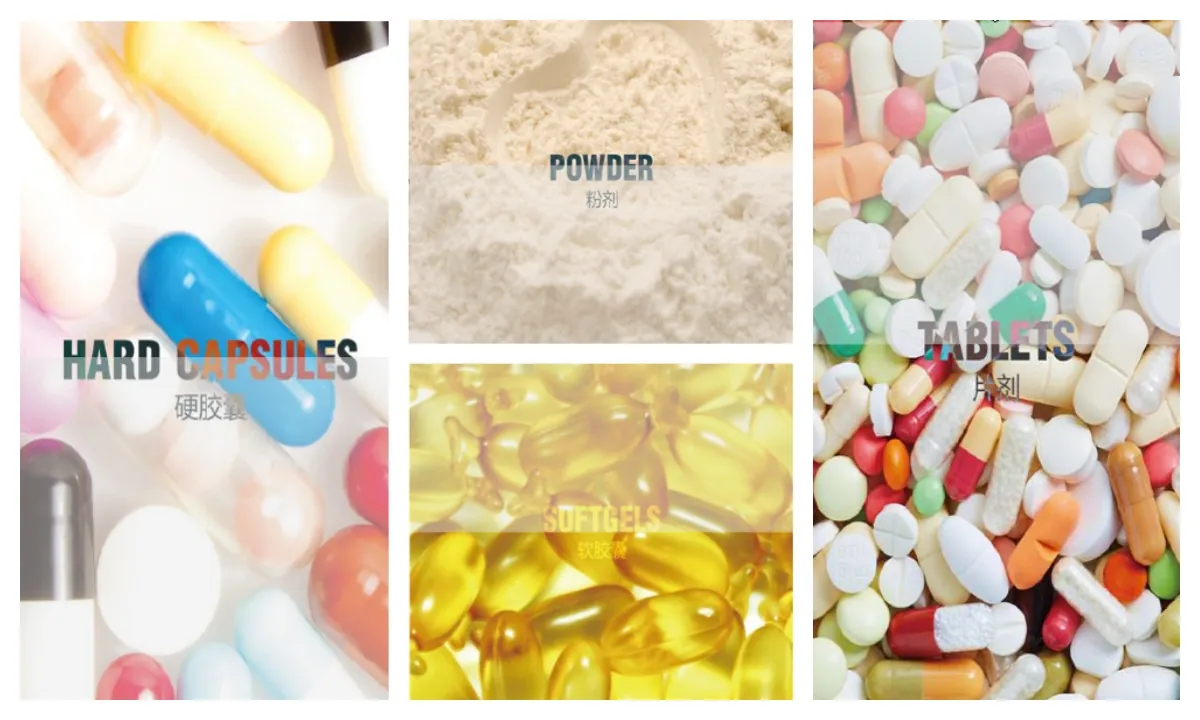
The dosage form is one of the first decisions in a supplement project, and it is hard to change later. It affects what you can put in the product, what it costs, how long development takes and how the goods travel. This guide compares the three forms most brands choose between.
The short answer
- Choose softgels when the active ingredient is an oil or dissolves in oil.
- Choose hard capsules when you have a dry powder and want to launch quickly.
- Choose tablets when the dose is high or the volume is large and cost per serving matters most.
Side-by-side comparison
| Softgels | Hard capsules | Tablets | |
|---|---|---|---|
| Best for | Oils and oil-soluble ingredients | Dry powders, extracts, blends | High doses, minerals, large volumes |
| Excipients needed | Carrier oil, shell | Few or none | Binders, flow agents, often a coating |
| Development time | Longest | Shortest | Medium |
| Cost per serving | Highest | Medium | Lowest at volume |
| Vegetarian option | Not offered; our softgels use gelatin | Not offered; our capsules use gelatin | Usually vegetarian by default |
| Shipping | Sensitive to heat and humidity | Sensitive to humidity | Most robust |
Softgels
A softgel is a one-piece sealed shell filled with liquid. That makes it the natural choice for fish oil, plant and seed oils, vitamin D3, vitamin E, coenzyme Q10 and carotenoids such as lutein. The sealed shell protects the fill from air, and consumers find softgels easy to swallow.
The trade-offs are cost and handling. Softgel production uses dedicated equipment and a drying stage, so unit cost and lead time are higher than for capsules or tablets. Softgels can also soften or stick together if a container gets hot, so summer shipments need more care.
See our OEM softgel options.
Hard capsules
A hard capsule is a two-piece shell filled with powder, granules or pellets. Because the powder does not have to be compressed, most formulas need little or no added excipient. That keeps the label short, which matters to clean-label brands, and it keeps development simple.
The limit is dose. A capsule only holds so much powder, so a high-dose formula may need two or three capsules per serving. If that makes the serving awkward, a tablet is usually the better answer.
See our OEM hard capsule options.
Tablets
Tablets pack the most active ingredient into a single piece and cost the least per serving at volume. They also travel well. Formats include plain and film-coated tablets.
Tablets need more formulation work. The powder has to flow and bind under pressure, so excipients are added, and the result is tested for hardness and disintegration. Some ingredients compress poorly or taste bitter, and those need a coating or a different form.
See our OEM tablet options.
Five questions that settle the choice
- Is the active ingredient an oil or a powder? Oil points to softgels. Powder points to capsules or tablets.
- How large is the dose per serving? Above what one or two capsules can hold, consider a tablet.
- Does the product need to be vegetarian or vegan? Choose tablets. Our softgels and hard capsules both use gelatin shells, so they are not vegetarian.
- Where will it be sold? Gelatin is an animal-origin material, and some markets apply extra import rules to it. Tell your supplier the destination before the shell is chosen.
- How quickly do you need to launch? Capsules are fastest, softgels slowest.
If you are unsure, send us the formula and the target market. We will recommend a form and explain why before you commit to a sample.
Frequently asked questions
Which dosage form is cheapest to produce?
At volume, tablets usually cost the least per serving, hard capsules sit in the middle and softgels cost the most. For small first orders the gap narrows, because development and setup make up more of the price.
Can the same formula be made in more than one form?
Often, yes. A dry powder blend can usually be filled into capsules or pressed into tablets. An oil-based formula normally has to be a softgel. Send us the formula and we will tell you which forms are workable.
Which form is quickest to launch?
Hard capsules, in most cases. They need the fewest excipients and the least development work, so the sample stage is short.